
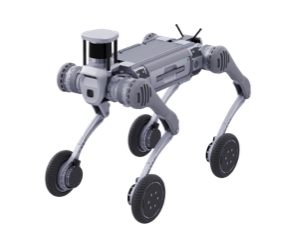
Unitree R1-D: A New Era of Robotic Mobility and Dexterity Unveiled
Unitree has introduced the R1-D, a quadruped robot designed to push the boundaries of robotic mobility and human-robot interaction. This advanced robotic platform is engineered for a variety of applications, emphasizing smooth transitions between different gaits and complex manipulation capabilities. The R1-D aims to provide a versatile solution for research, industrial, and domestic environments.
Advanced Mobility and Dynamic Transitions
The R1-D distinguishes itself through its sophisticated locomotion system, capable of seamlessly switching between multiple gaits. This includes dynamic movements such as trotting, running, and even a quadrupedal walk resembling that of an animal. The robot's design prioritizes stability and agility, allowing it to navigate diverse terrains with considerable speed and efficiency. Its articulated legs and advanced control algorithms enable it to adapt its movement patterns in real-time, responding to environmental changes and task requirements.
Dexterous Manipulation and Human-like Interaction
Beyond its impressive mobility, the R1-D features a dual-arm system designed for dexterous manipulation. These arms are capable of performing a wide range of tasks, including grasping, carrying, and interacting with objects. The robot's design incorporates aspects aimed at facilitating closer collaboration with humans, potentially enabling it to assist in tasks requiring both locomotion and precise manipulation. This integration of walking and grasping capabilities positions the R1-D as a significant step forward in creating robots that can operate more naturally alongside people.
The Unitree R1-D represents a notable advancement in robotic technology, combining robust quadrupedal mobility with dexterous manipulation through its dual-arm system. Its ability to perform dynamic gait transitions and engage in complex manipulation tasks highlights its potential as a versatile platform for future robotic applications.